Remembering Roger in 2022
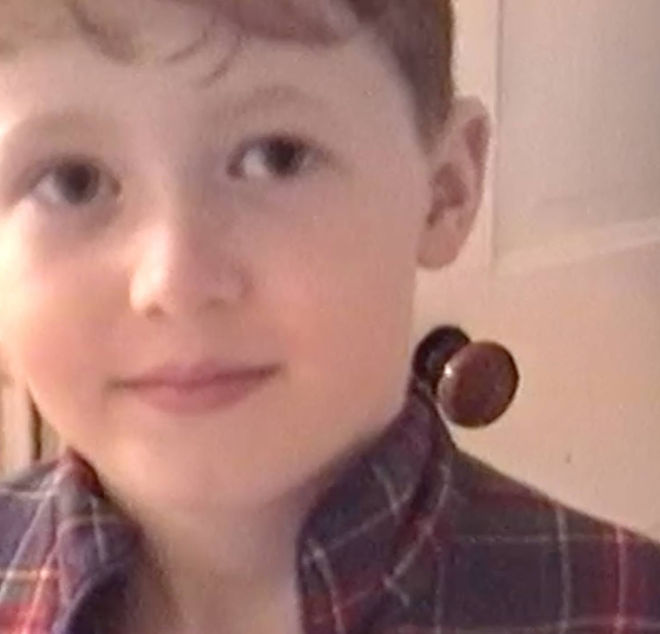
From the moment I held him as an infant, his eyes held the secrets of the universe. As a toddler, Roger loved reading and telling stories. His identity as a storyteller and writer began even before he was started school. As a toddler, he would climb up onto my office chair and play with the keys on my computer, calling out the letters by name. As a preschooler, he scrawled stories by making pictures crayons, explaining the narrative was he drew. One day, the preschool teacher handed me a delightful set of scribbles that featured the story of a robber who gets caught and put in jail for his crimes.
Both my young children were prodigious talkers. Wandering a yard sale in suburban Boston one summer, I had stumbled upon a set of the scientific-looking cards. It was the Peabody Picture Vocabulary Test, a type of psychological test that measures listening and understanding skills through vocabulary comprehension. When a word is read aloud, children simply touch or point to pictures. When I tried out the test with Roger at age five, he had the vocabulary of a 15-year-old. No wonder I was amazed by him nearly every moment of the day. The boy was chock full of words.
Roger was special. He also had special needs. When his preschool teacher suggested we get a neurological evaluation for him at age three, her main concern was that Roger did not like to play at the water table with the shaving cream. Such a trivial concern initially came as a surprise to us: how could little Roger’s distaste for playing with shaving cream play be a medical issue?
But we scheduled the appointment anyway. We arrived at Boston Children’s Hospital with Roger rand his baby sister Rachel for the neurological evaluation. The doctor asked him to do a set of tasks that measured his vision, hearing, touch, body awareness, balance, motion, and motor planning.
Randy and I filled out various forms. We worried. We waited.
Soon the diagnosis came to us via a letter and phone call: Roger had a developmental delay in sensorimotor integration.
“Roger’s brain is working hard to organize and use all the sensory information to understand experiences and respond to his environment,” the doctor explained. “He is delayed as compared with other children his age.” The doctor explained that Roger does not have autism. His verbal and nonverbal communication skills are fine.
All I really remember about the call is asking about that unfamiliar term, “sensorimotor integration.” What does it mean?
“Roger is struggling to coordinate all the sensations: sight, movement, sounds, textures, touch, and smell,” explained the doctor.
That sounded like a real problem to me. But how bad was it really? But Randy and I had already noticed things about Roger during his first three years. Groups of people and loud noises of all kinds were excruciating to him. As a baby, he never crawled. Roger was the scooter: he didn’t use his knees and legs to get mobile. He scooted around, often at great speed, on his butt. With one leg bent forwards, his left foot on the floor, he pushed with the opposite arm. Other times, he sat, hips wide apart, knees bent and feet on the floor, rocking his pelvis forwards and backwards. He could get around pretty well this way.
Sensorimotor integration is treatable, the neurologist explained. For Roger, coordination of his bodily actions is more effortful than for other children. It might take more time for him to respond to novel situations; he might struggle with interacting with groups of people.
“Occupational therapy will help him learn to use coping strategies as part of everyday life,” he said. “Over time, Roger will learn to coordinate how his body moves in space. He will need more time and more practice to learn a new motor skill.”
Sitting there in the doctor’s office, holding the children in our laps, we were relieved.
“He probably will never master team sports,” the doctor said. “But he will be able to play more individual sports like martial arts and golf. By the age of 25, he will catch up to everyone else when it comes to the integration of sensorimotor information.”
Randy and I each gave our three-year-old boy and his baby sister a big, warm hug. Motor skills issues? Neither one of us was that into sports.
Indeed, we are both rather large, slow, clumsy people.
Reflecting back on it, at the time, this diagnosis didn’t seem like a big deal, given that it involved a trip to the hospital – and it could have been something much worse. We were relieved and bemused. Our son would be just fine, even if he was not destined to be a basketball star. We would start the occupational therapy right away, as the doctor had recommended.
Roger would be just fine.
As he grew, in small moments, he revealed his gifts and talents to the world. Roger stood apart from other children in one way or the other. He didn’t do anything spontaneously or impulsively. When we asked him a question, we learned to provide “wait time” as Roger took time to formulate an answer. The answer was always worth waiting for, as it came out in complex sentences, elegantly formed, witty and charming. Mrs. Mahoney, his third-grade teacher, marveled at his creative stories as well as his kindness to other children and his gentle manner. She went out of her way to be kind to me, too. On more than one occasion, she looked me straight in the eyes and smiled, saying, “You have a special child there.”
When Roger and Rachel were in elementary school, they participated in an afterschool program called Odyssey of the Mind. Although we had tried scouting and all the sports we could think of – soccer, martial arts, swimming – Odyssey of the Mind was the only organized youth activity our kids ever really enjoyed (until they discovered the magic of summer camp). It was a competitive and collaborative problem-solving educational program that integrated art, music, science and drama.
In the Odyssey of the Mind program, groups of students worked together, in a self-managed team, to solve problems. For example, one typical problem asked each team to create and present a humorous performance that includes an inanimate object that comes to life. Another problem asked teams to design, develop and implement a system that sorts and transports domestic mail, foreign mail, and packages sent through a distribution center to their proper destinations. The 8-minute production was required to include a team-created poem or song and original music. Teams worked on problems for a period of a couple of months and then competed locally, regionally, nationally and internationally and prizes were awarded to the most creative solutions.
There were also competitive games of spontaneous creativity. Teams practiced and prepared for the experience but the actual problem they solved was not revealed to them until they walked into the competition. In these competitions, quick thinking, creativity, teamwork, and the ability to deal with the unexpected were judged. In one activity, problems require teams to give verbal, spoken responses to questions or prompts, and those responses are scored according to how creative (or common) they seem to parent judges. In other problems, physical interaction among team members is required to solve a problem as they must move, build, or to use everyday items to complete a task. Kids work under extreme deadline pressure, solving a problem in generally under 10 minutes.
In one competition, I remember watching from the sidelines in the school gymnasium as Roger’s team participated in a spontaneous challenge. Other kids were quick and fast, generating lots of ideas. But they were, for the most part, trivial and superficial. From the sidelines, my own mind was spinning with numerous creative solutions to the problem the group had been given. I could see that Roger was thinking actively, listening to others, but he was quiet and solemn, behaving very differently from the other children. I vividly remember the agony and strange shame of a parent whose child is underperforming.
Finally, Roger visually signaled his intention to speak. The children on his team huddled around him, quiet and intensive. They waited. They waited some more. Finally, out came the idea – I couldn’t hear what it was -- and the kids on his team smiled and nodded. They talked over how to incorporate his solution into their work. Although Roger’s team did not win the competition, they came in second place. Roger’s eyes were shining with excitement when the competition had concluded. His ideas could be turned into action.
During the award ceremony, his team received a special commendation for creativity from the judges. I remember the mixed feelings of pride and relief as I saw how Roger was able to express his imaginative ideas while developing social competencies in working with other children. When asked to contribute out-of-the-box and original solutions to a problem, Roger could be celebrated and rewarded.